
Track AIPAC Adapting Data Methodology to Identify the Israel Lobby’s Hidden Donor Movements
March 27, 2026
Update (April 28, 2026): We have decided to revert from our recently launched V3 methodology back to V2 in an effort to improve data clarity and avoid confusion as we build out a publicly searchable database for V3 data. Click here for our official statement on this change.
As a data transparency project, Track AIPAC has always been committed to making publicly available, reportable campaign finance data easier to see and understand for the average person.
Specifically, we set out two years ago to identify which of our Representatives and Senators were being influenced in their policies, public statements, and most importantly, their votes on military aid to Israel in the midst of their ongoing genocide in Gaza.
While our data methodology has necessarily evolved, our guiding principles have remained the same from our first day:
Our assessments are firmly rooted in public contributions, public data, public statements, and public votes.
While we selected the name Track AIPAC as a public education tool, we have always tracked and reported on the entire pro-Israel lobby.
We track the lobby money wherever it goes, regardless of party identity or any personal feelings about a given lawmaker or candidate.
In this blog we’re going to break down the evolution of our data analysis – where we get our data, how that data is assessed and presented, and what steps we’re taking to improve our processes.
V1.0 (2024): Data sourced from existing campaign finance watchdog groups
The very first posts for Track AIPAC launched two years ago this month. The look of the graphics has changed, but the core elements were always there: Name, position, lobby total, data source.
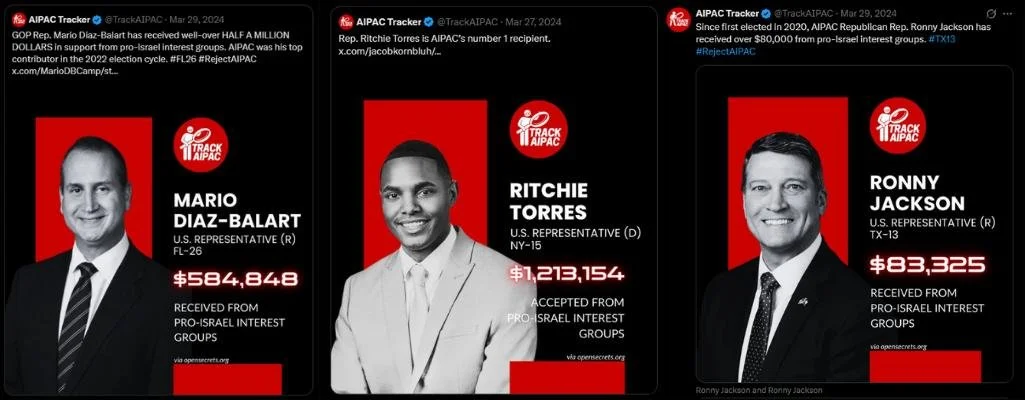
As a small group of volunteers, we reached for the data that was available to us, and turned to sources like OpenSecrets for the majority of the information we reproduced in graphic form.
We first went to the list of Pro-Israel lobby groups tracked by OpenSecrets (which is broken down by cycle), and searched their database for direct donations made to candidates from pro-Israel PACs.
But the further we went, we discovered that despite their extensive efforts, existing watchdog groups didn’t have a complete picture of the lobby’s influence.
So our data scientist volunteers got busy building tools to pull the data directly from the source of record – the Federal Election Commission itself.
V2.0 (2025): FEC Data on direct donations from PACs to candidates + independent expenditures
By the end of 2025 we were tracking more than 50 PACs in the lobby (compiled on our website here under More AIPAC Allies).
Pulling the donation and independent expenditure data directly from the FEC database also allowed us to better represent the full picture of the lobby’s influence on a single representative or election – best demonstrated in the 2024 primaries against Rep. Jamaal Bowman and Rep. Cori Bush.
Bowman and Bush’s opponents were openly backed by AIPAC and their super PAC, United Democracy Project, producing two of the most expensive House primaries in the history of American politics.
To defeat Bowman and Bush, AIPAC and their allies spent a combined total (that we knew of at the time) of $31,383,244.
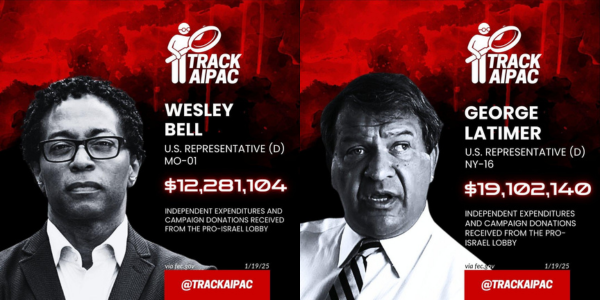
This new visibility began to radically change the dialogue around AIPAC.
As our social media following surpassed AIPAC themselves, our red graphics began to pop up everywhere online.
Lawmakers changed course as well. Members of Congress began to reach out to us and request a dialogue. More and more candidates began to reject AIPAC money from the outset of their campaigns.
And voters made it known that they would no longer support candidates who take support from AIPAC or their allies like DMFI and RJC.
But the biggest change came from AIPAC’s own behavior.
On October 17, 2025, journalist Matthew Eadie of Evanston Now broke the story State Sen. Laura Fine was receiving AIPAC support through backchannels – large AIPAC donors making coordinated contributions directly to Fine’s campaign via secret donation portals where they would never be earmarked as associated with AIPAC.
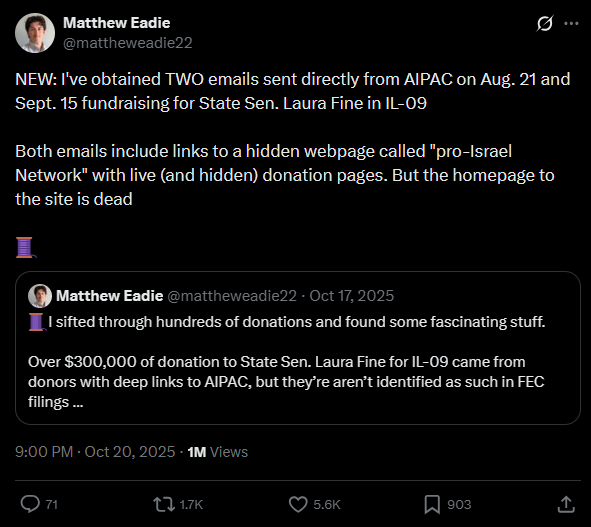
The moment we saw Eadie’s reporting, we knew we had to adapt our methodology again and find a way to track these donations as well. So we went back to our data scientist and got to work.
V3.0 (2026): Adding large Israel lobby donors giving directly to candidates to the existing data set
It took several months of building and testing new reporting models, working out the bugs, and finding the errors in the FEC’s own data set (duplicated names, incorrect committee IDs, etc.), but by early 2026 we were ready to start mapping FEC reportable ($200 or more) donors with a history of giving to pro-Israel PACs who were also making contributions to candidates.
In nearly every case, lawmakers with a history of receiving open support from AIPAC and their allies via PACs and independent expenditures also received a large volume of direct contributions from the lobby’s donor network. That meant the numbers jumped up, almost across the board.
You can track the evolution of the numbers through AIPAC’s spending on Reps. Wesley Bell and George Latimer.
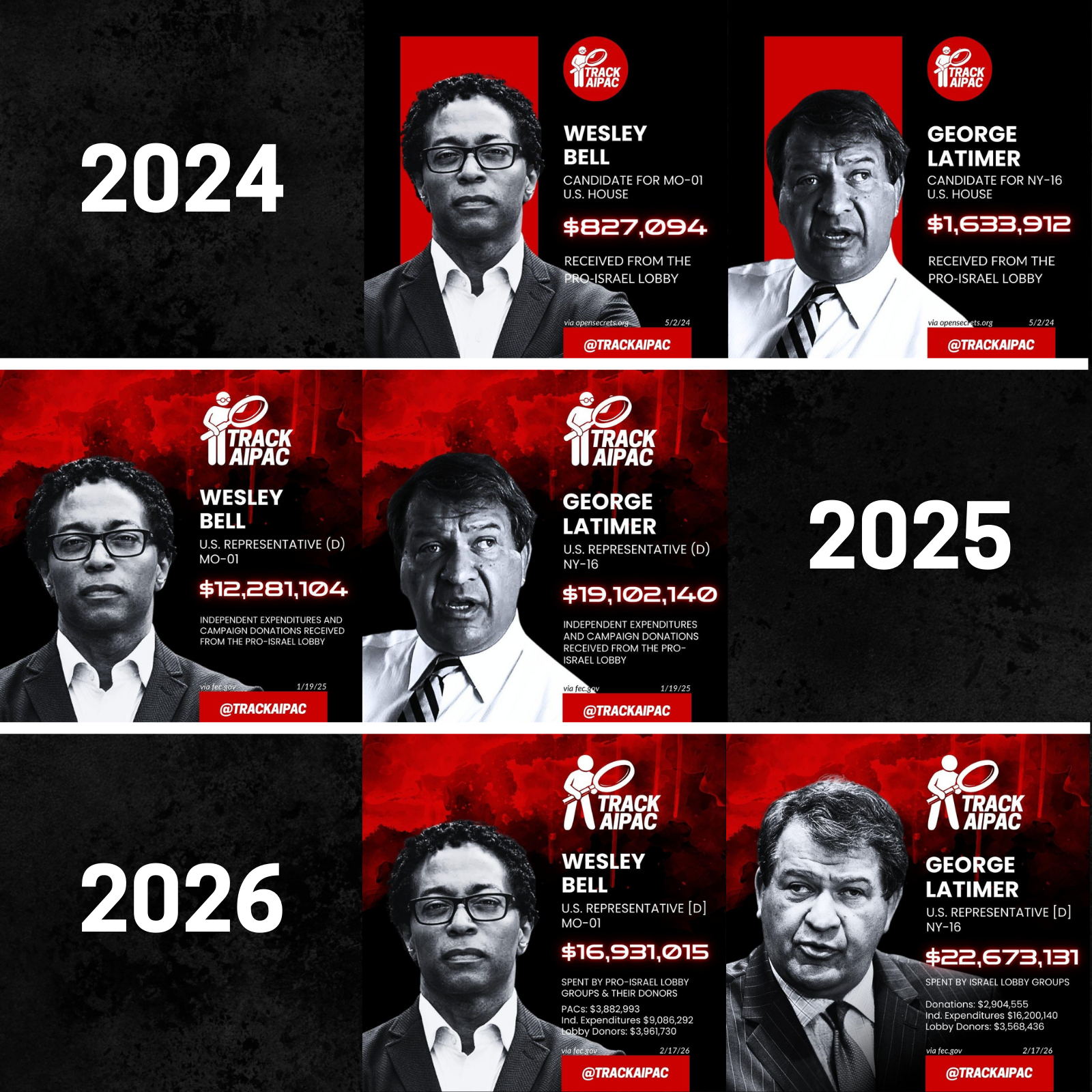
This adapted methodology makes it harder for the lobby, especially large players like AIPAC whose brand has become a liability for campaigns, to hide their ongoing influence by removing themselves as a visible conduit.
It also gives us the most comprehensive view to date of which candidates these donor networks are supporting, even when they actively try to hide their support through a sprawling network of pop-up shell PACs (more on this in a future report) and secret backchannel donation pages.
The figures we report represent federal career totals. Our reports do not capture state level campaign finance data as each state has their own campaign finance reporting system and we do not have the infrastructure or personnel needed to track those – yet.
The key ingredient: Legislative records and public statements
The finance record alone is not enough to land a member of Congress (or a candidate) with a red graphic. Our scorecards represent a nexus of lobby spending and the candidate’s policy record.
Red graphics are assigned when we evaluate a candidate’s policy as pro-Israel based on their voting record (if one exists), any published policy positions, any public statements, and any credible reporting verifying that the candidate is seeking AIPAC’s support – often by circulating secret position papers favorable to Israel.
If a candidate is identified as being pro-Israel based on these public records, and campaign finance data is not yet available, we will assign a “WARNING!” label to their graphic.
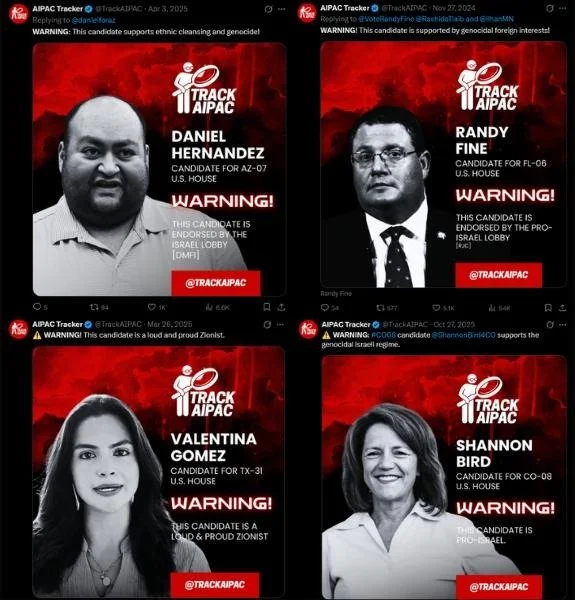
For current members of Congress, we turn to the Congressional Democrat Palestine Tracker maintained by members of the New York DSA and linked to our website under Resources.
While a comparable Republican Palestine Tracker does not yet exist (that we’ve found), we do intend to build one when time and resources permit.
For the time being, so few Republicans break with the Israel lobby that tracking it is relatively easy: There have only been two in the two years that we’ve been in operation.
One has just resigned from Congress. And AIPAC is working feverishly to unseat the other.
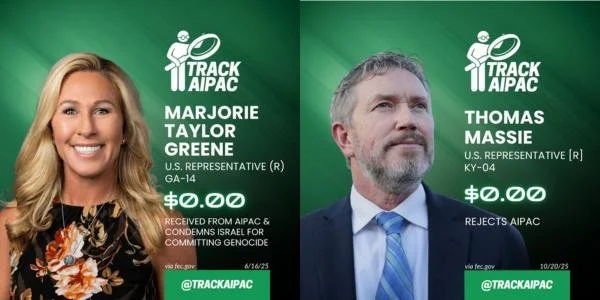
Note: Green graphics on their own are not endorsements. They are simply scorecards representing Israel lobby influence.
More Changes Coming Soon
As AIPAC and their allies continue to evolve their tactics, and as data sources and reporting tools continue to improve, we continue to refine our methods as well.
Recent feedback on our methods has made it clear to us that our graphics do not fully represent the data points that go into the process – especially the legislative and public policy record.
While we have always published receipts justifying the policy record when posting our red and green graphics, that context gets lost quickly when the graphics are reposted in other contexts later.
Our forthcoming graphic design will clearly incorporate specific policy points that factor into our analysis.
We’re also currently undergoing a full website rebuild, and look forward to providing more robust tools that will substantiate the public record and explain the totals reported from the FEC data.
Look for further updates as these new features are rolled out.
Thank you,
The entire team at Track AIPAC